
The Temperament Appetizer
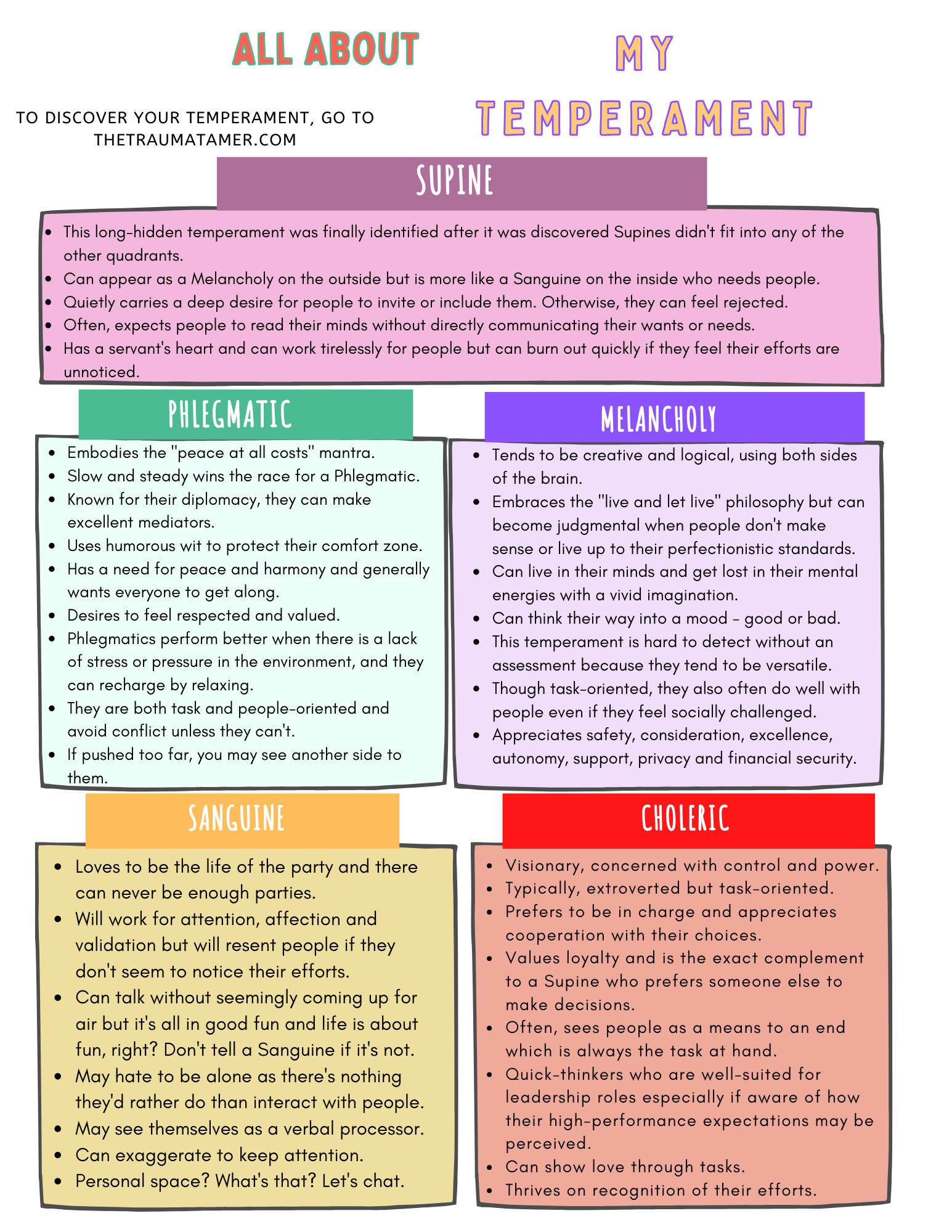
See if you recognize yourself or anyone you know in these brief overviews. There are no bad temperaments—just differences we can navigate if we know what they are.
Note: Most people are a unique "recipe" of these traits, often blending different temperaments across different areas of life.
The Full Five-Course Meal
Temperament isn't just one label—it's a complex recipe that manifests in three distinct areas of your life.
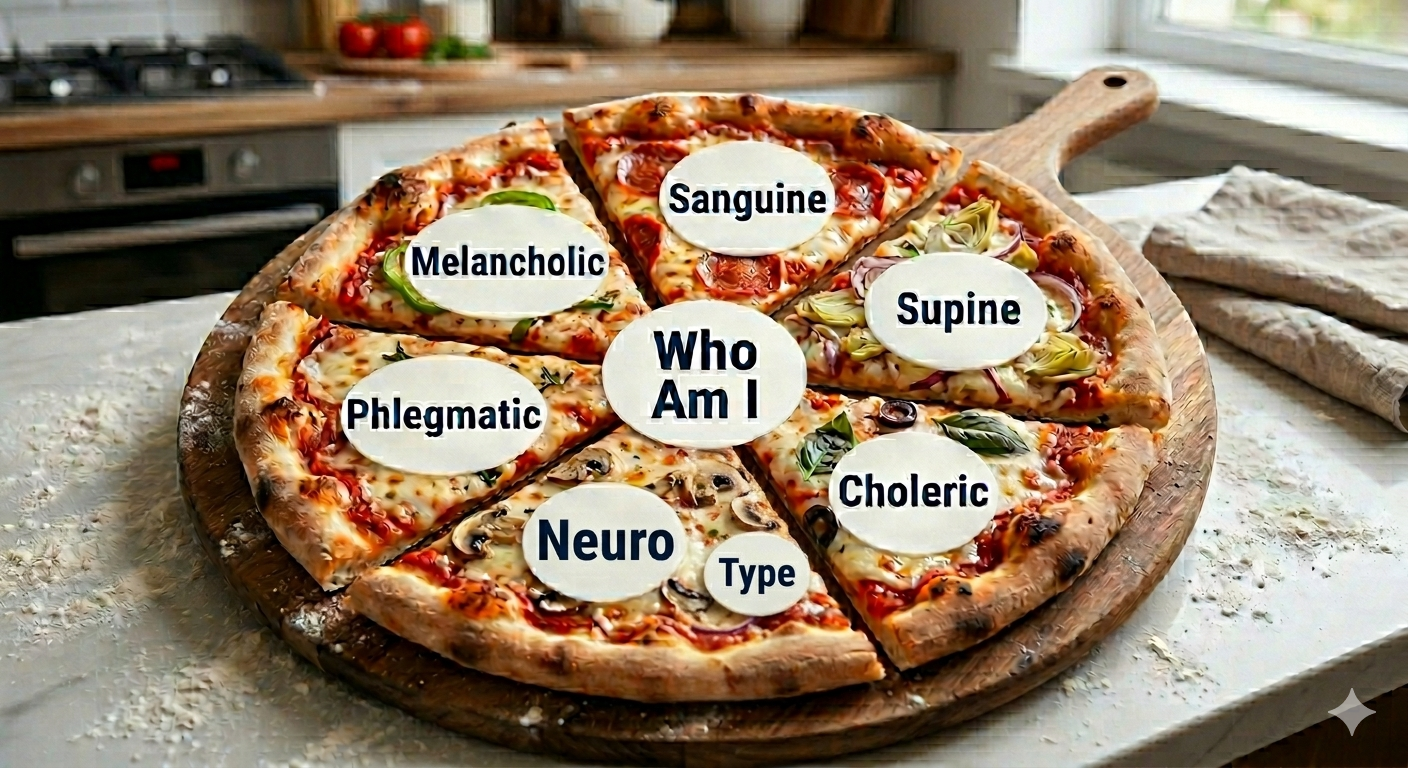
Just like a pizza with different slices, you might have a "slice" of Sanguine in your social life, a "slice" of Melancholic in your work, and a "slice" of Supine in your intimate relationships.
Intellectual & Social
How you interact with the world, process information, and manage your social energy and boundaries.
Decision-Making
The internal engine that drives your choices, your need for control, and how you handle power and responsibility.
Close Relationships
Your deepest needs for affection, vulnerability, and connection in your most intimate circles.

Meet Your Temperament Translator
My journey here was circular. It began in 2010 with my own temperament assessment—an experience so profound it felt like it was reading my soul, capturing things about me that no personality test ever could. That insight haunted me, in a good way, for years.
I went on to become certified in integrated attachment theory and pursue a license in temperament counseling. But even after researching attachment to what felt like the ends of the earth, I knew a piece was still missing. I saw how two people with the same attachment style could be fundamentally different, and I needed to know why.
That question led me back to the beginning: temperament. I realized it was the original wiring that explained the person beneath the attachment pattern. The answers I found in that small, cozy room in 2010 were the ones that filled in the blanks left by every other field.
Now, I want to share those secrets with you. My work isn't about "reading your mind," but about giving you access to all of you. It's about making conscious choices that honor your true self, so you no longer feel forced to be someone you're not to gain approval. The approval is already there. It's just waiting for you to find it.
Beau Bristo, MS, CLC
Temperament Counselor & Translator
Your Investment
Transparent pricing to help you start your journey toward understanding your original wiring.
The Assessment & Personal Report
A private assessment link and a condensed, user-friendly report for your own records. A modest entry point for those who want to start their journey.
The 60-Minute Deep-Dive
The assessment, the condensed report, PLUS a 60-minute Comprehensive Review where we walk through the deeper, more thorough results not found in the brief report.
Follow-up Counseling Session
A standard 50-60 minute session for those who have already had their results review and want to continue the work.
* If you are in a season of financial hardship, please reach out—I never want cost to be the barrier to your healing.
Framework
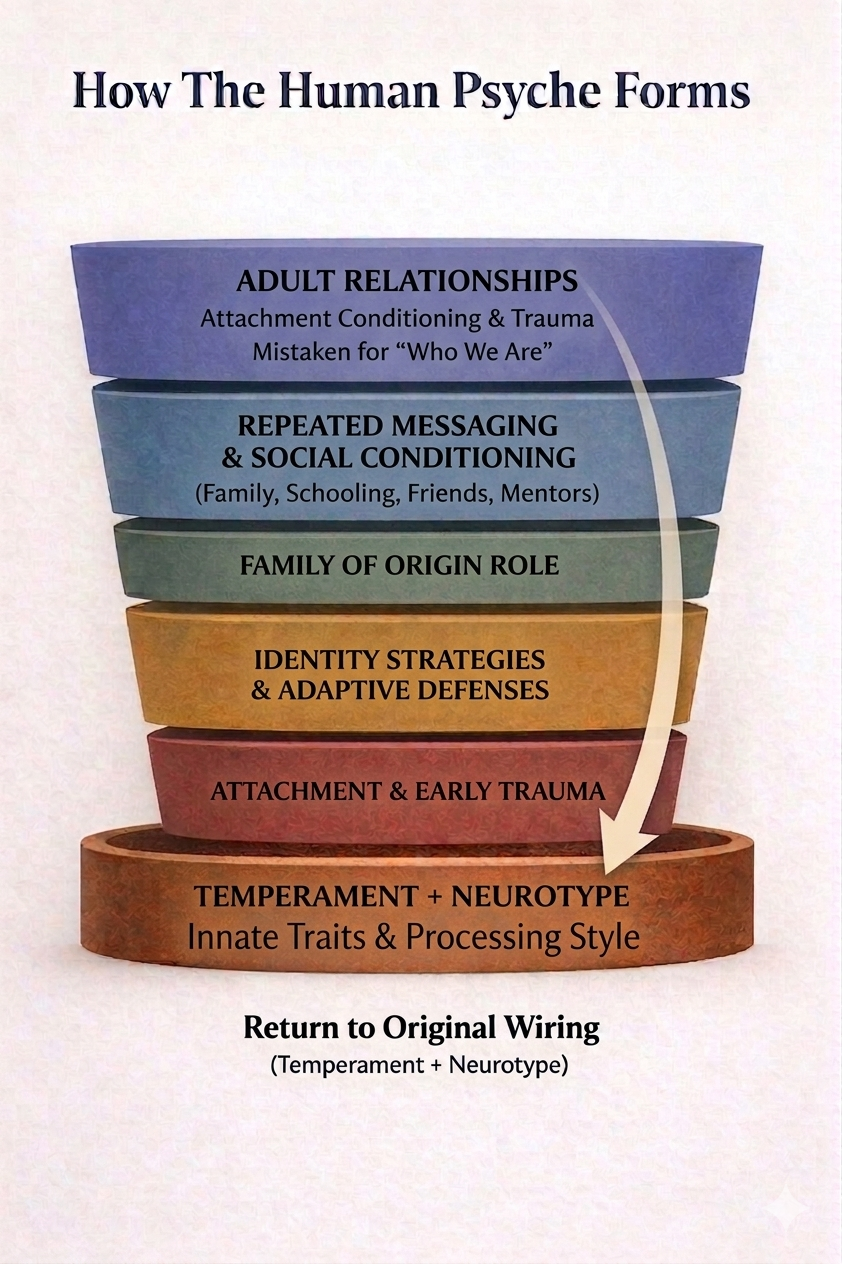
The Human Build Sequence
Most frameworks begin once behavior is already visible. This one starts earlier. The adult pattern matters, but it sits downstream from native wiring and the slow architecture of becoming.
Temperament + Neurotype
Every human arrives with native traits and a specific processing style. Sensitivity, rhythm, intensity, and neurotype are not afterthoughts. They are the original wiring.
Attachment & Early Trauma
Those native traits meet caregivers, environment, stress, and repair. Attachment patterns emerge partly from what happened and partly from who was there to experience it.
Identity Strategies & Adaptive Defenses
The child learns what gets closeness, what gets rejection, and what version of the self seems safest to become. Adaptations organize around reality; strategy begins to harden.
Family of Origin Role
We are often assigned or adopt roles within our first community—the hero, the scapegoat, the lost child. These roles further shape how we express or suppress our true nature.
Repeated Messaging & Social Conditioning
Schooling, friends, mentors, and culture layer on expectations. Over time, repeated choices and pressures shape the way a person carries themselves in the world.
Adult Relationships
Conflict, meaning, and identity all carry the imprint. Often, we mistake these adult patterns for 'who we are,' forgetting they sit downstream from our original wiring.
Differentiators
- ✅ We start before behavior exists.
- ✅ Temperament explains why attachment strategies form.
- ✅ A whole-human model restores developmental context.
The Journey Back to Original Wiring
Mapping Your Relational Landscape
Before we can translate your soul, we must first locate where you are in your current relational patterns.
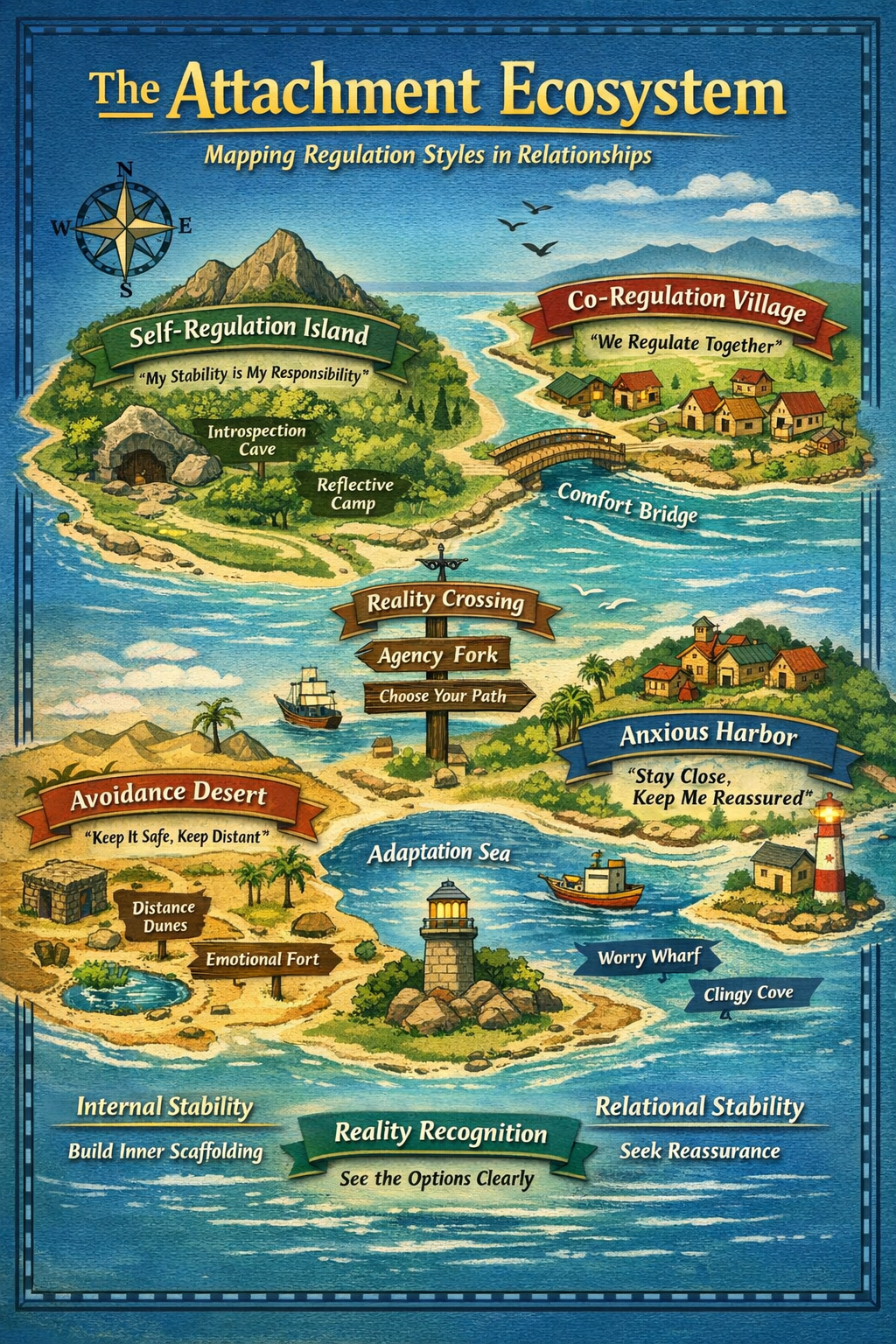
Whether you find yourself in the **Anxious Harbor**, the **Avoidance Desert**, or navigating the **Adaptation Sea**, these patterns are not your identity. They are the "regulation styles" you've adopted to find stability. Our work is to build the "Comfort Bridge" back to your original wiring.
Not ready for the deep-dive yet?
If you are currently navigating the storm of narcissistic abuse or relationship trauma, you may need to "tame the trauma" before you can translate your soul.
My foundational work at **The Trauma Tamer** is designed to help you deconstruct survival defenses and reclaim your peace, creating the safety needed for the deeper work of temperament translation.
Visit The Trauma Tamer
The Trauma Tamer
Foundational Healing & Recovery